
STANDTRACK
Digitalisation and traceability for more sustainable last-mile urban logistics
Last-mile traceability tested in pilot schemes in Vitoria-Gasteiz, Madrid and Braga.
What is the project?
StandTrack is a digitalisation and traceability platform that uses a unique consignment identifier (UCI) to share standardised information between operators, without any of them having to abandon their own management systems.
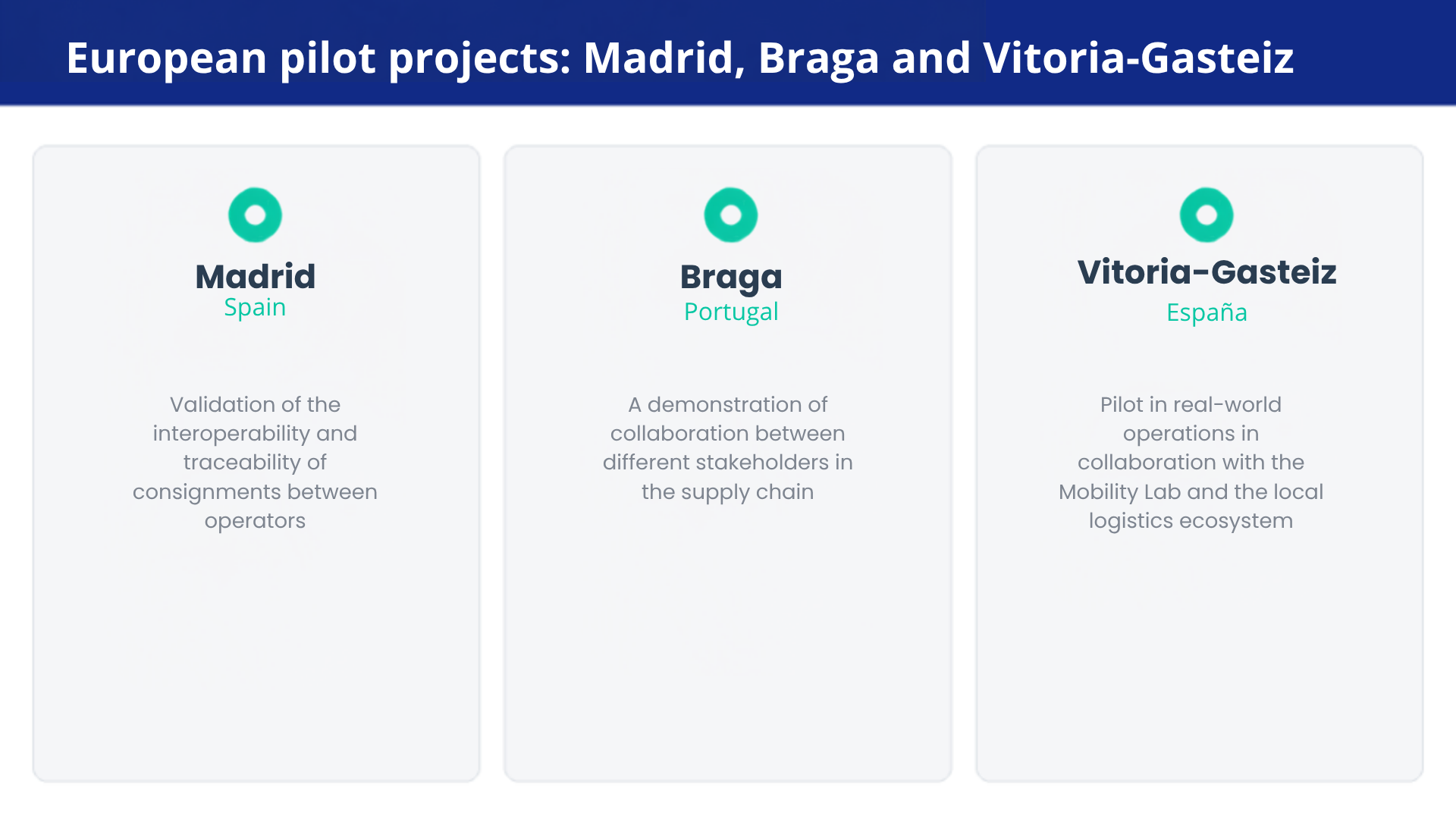
The project has been tested through pilot schemes in various European cities:
1. Madrid (Spain): to validate the interoperability and traceability of shipments.
2. Braga (Portugal): to test secure collaboration between logistics operators.
3. Vitoria-Gasteiz (Spain): a pilot scheme involving real-world operations in collaboration with the Mobility Lab.
The challenge: logistics information scattered amongst different operators
Before the pilot, each operator managed its own data without a common standard for sharing it amongst themselves.
-

No shared traceability
Each operator used its own management systems, without a common shipment identifier.
-

Uncoordinated routes
Operators organised their routes independently, without consolidating goods at the microhub.
-

Urban barriers
The medieval centre of Vitoria-Gasteiz combines the future Low Emission Zone with architectural barriers.
-

Limited interoperability
There was no standard model for sharing information between operators, apart from an incomplete private system.
Pilot approach:
The pilot project implemented StandTrack in real-world urban distribution operations in Vitoria-Gasteiz, in collaboration with the Mobility Lab and the local logistics ecosystem.
- Unique Parcel Identifier (UPI)
- Consolidation of routes at the San Martín microhub
- A tour of the medieval quarter of Vitoria-Gasteiz
The pilot project focused on a real-world delivery area, in collaboration with two local logistics operators:
-
 End-to-end traceability: tracking parcels from the microhub through to last-mile delivery
-
Route consolidation: two local operators are based at the San Martín microhub, with support from Eraman
- Pilot area: distribution focused on the western streets of the medieval quarter and the neighbouring streets
-
 Volume tested: 20 single-parcel consignments distributed amongst each operator during the pilot
Project objectives:
The pilot scheme made it possible to validate a more collaborative, efficient and sustainable logistics model for the last mile.
-
1
Secure collaboration between operators
-
2
Optimisation of operations and reduction in incidents
-
3
Consolidation of goods from the microhub
-
4
Validation of StandTrack as a cooperation tool
-
5
Support for the DataDUM project
The solution: the StandTrack platform
A pilot scheme that tracks the last mile in four stages, from receipt at the microhub to the evaluation of results.
Areas of development:
-
Phase 1: Check-in at the microhub
-

Phase 2: Route consolidation
-

Phase 3: Distribution with IUB
-
Stage 4: Traceability and monitoring
-

Evaluation of results
Technological capabilities:
-

Unique Parcel Identifier (UPI), which standardises information between operators without replacing their management systems.
-

Joint receipt of goods from both operators at the San Martín microhub.
-

Organisation of shared routes, regardless of the company of origin.
-

Deliveries in the western streets of the medieval quarter of Vitoria-Gasteiz and the neighbouring streets.
-

Monitoring of 20 single-parcel consignments per operator to validate continuous traceability.
Equipment and transfer
A project focused on interoperability, traceability and collaboration amongst stakeholders in the logistics chain.








Funding
Project funded by the MobilityLab Foundation
Implementation period: 2024–2025
