
The event held at Hibridalab showcased the permanent experimentation channel for mobility and logistics in Vitoria-Gasteiz and Álava, along with two challenges proposed by the City Council and the Provincial Council.
■ Innovation Lab provides innovative companies and organizations with access to eight experimentation spaces, resources, data, and support to test solutions under real-world conditions.
■ The first Challenges seek a platform to certify bicycle trips in Vitoria-Gasteiz and technologies to prevent accidents caused by wildlife on rural roads in Álava.
■ The event brought together institutions, companies, and innovation stakeholders to learn about ways to participate and share experiences with experimentation in the region.
Translated with DeepL.com (free version)
The Vitoria-Gasteiz Araba Mobility Lab Foundation presented Innovation Lab at an event held on October 29, 2026, at Hibridalab on the Álava University Campus. The event provided an opportunity to learn about how the initiative works, the resources available for developing pilot projects, and the first two Challenges, which focus on active mobility and road safety.
During the presentation, Iñaki Gurtubai, Provincial Councilor for the Basque Language, Equality, and Governance at the Provincial Council of Álava, emphasized: “Álava is strategically located as a link between the Iberian Peninsula and Europe, with first-rate logistics infrastructure and a highly capable business community. When we launched Mobility Lab in 2022, together with the City Council of Vitoria-Gasteiz, we knew we had to harness that potential and invest in projects that companies would struggle to undertake on their own. Innovation Lab embodies precisely that commitment: to provide a real-world testing ground where companies can experiment, take risks, and develop innovative solutions. “We have invested more than five million euros and succeeded in attracting more than four million in funding to the region. These results demonstrate the value of this institutional collaboration and our commitment to Álava’s competitiveness and future.”
Izaskun Reyes, council member for Maintenance and president of TUVISA at the Vitoria-Gasteiz City Council, emphasized: “We at the City Council are aware of the problems that arise on a day-to-day basis, but we also know that companies, universities, and research centers have a lot to contribute. We want to hear their proposals and make it easier for those that may prove useful to be tested in Vitoria-Gasteiz.”
For his part, Iñigo Bilbao, director of Mobility Lab, noted: “Álava has enormous potential in areas such as intermodal logistics—centered around the Jundiz hub—and batteries, with a leading business and technology value chain. At Mobility Lab, we have already connected with more than 190 companies, brought four companies onto our Board of Trustees, and secured 3.8 million euros through seven projects. Now we want to take it a step further: with Innovation Lab, the Challenges, and MOVDATA, we’re providing companies with spaces to experiment, real-world challenges, and the capabilities to leverage data—all with the goal of transforming that potential into concrete projects that generate value for Álava.”
A permanent channel for testing mobility and logistics solutions
Innovation Lab functions as a living laboratory and a permanent channel for accessing local resources to test mobility and logistics solutions. Through this permanently open channel, any public or private entity—whether individually or as part of a consortium—can propose pilot projects, demonstrations, or validation tests in real-world environments or settings that replicate real-world conditions of use. Mobility Lab supports these entities from the preparation of the application and the definition of the tests through to their execution, monitoring, and evaluation, to facilitate project development and assess their potential for continuation or implementation on a larger scale.
The initiative is organized into eight areas of experimentation: autonomous, connected, and clean vehicles; drones and unmanned aerial vehicles; last-mile urban delivery; intermodal logistics; smart public transportation; active mobility and micromobility; road safety and accessibility; and high-capacity roads. To support these projects, Mobility Lab has a facility and technical equipment for developing prototypes and conducting tests. These resources are complemented by MOVDATA, its mobility and logistics data platform, which facilitates data access and exchange in a trusted environment.
During the event, María Suberbiola, Innovation Specialist, and Jihan Ochen, European Projects Specialist, both from Mobility Lab, demonstrated how this process works through a practical example and a tour of the new website, covering everything from accessing resources to submitting an application.
Information and Participation in Innovation Lab
Two Challenges to Address Local Needs
The Challenges complement the Innovation Lab’s ongoing platform with specific calls for proposals that connect the needs of local governments with innovative solutions that can be developed and tested in the region. In this first edition, two challenges proposed by the City Council of Vitoria-Gasteiz (CEA) and the Provincial Council of Álava were announced, aimed at companies and organizations capable of developing and validating new solutions.
Juan Carlos Escudero Achiaga, head of the Mobility and Data Science Division at the CEA of the City of Vitoria-Gasteiz, also participated in the presentation of the challenges.
Certification of Bicycle Trips in Vitoria-Gasteiz
The active mobility challenge, promoted by the City of Vitoria-Gasteiz, seeks a platform that allows for the certification of bicycle trips.
Prevention of Accidents Caused by Wildlife on Rural Roads in Álava
The road safety challenge, promoted by the Provincial Council of Álava, seeks technologies to help prevent accidents caused by wildlife on rural roads in the region.
Information and Participation in the Challenges
Experimental experiences shared during the conference
The panel discussion “The Territory as Infrastructure for Innovation” brought together Rafael Mouliaá, section chief at the General Directorate for Policies Against Depopulation of the Ministry for Ecological Transition and the Demographic Challenge; Iratxe García, director of the Basque Institute of Logistics; Sara Barreal, Director of Strategy for Sustainable Mobility for the Basque Government; and Jorge Tejedor, Director of Entrepreneurship, Employability, and Technology Transfer at the Álava Campus of the University of the Basque Country.
Moderated by Geana de Miranda Leschko, manager of the Urban Innovation and Public Policy Division at TECH friendly, the session addressed the role of experimentation in public and business innovation and its contribution to generating evidence for decision-making.
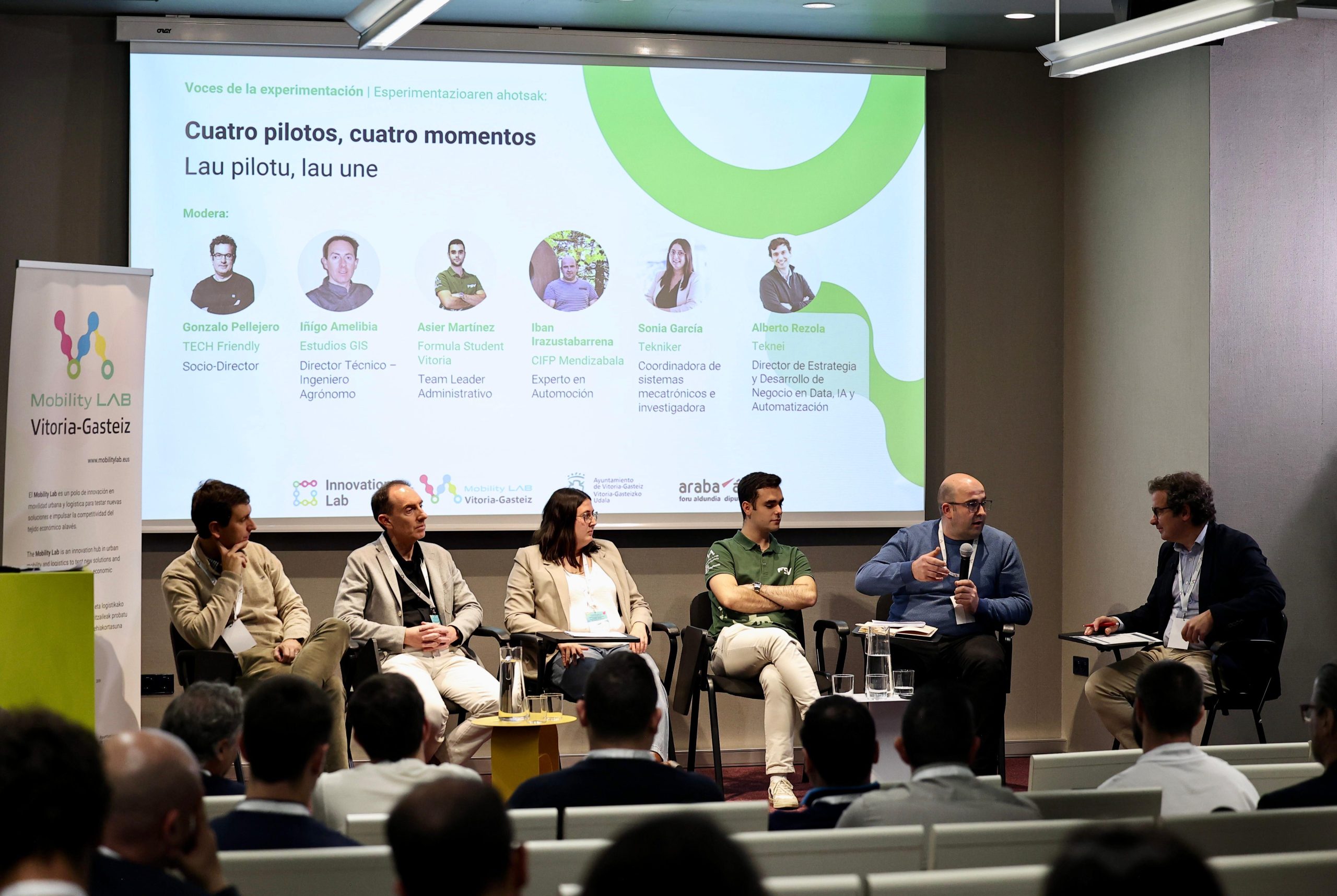
At the “Voices of Experimentation” panel, Estudios GIS, Formula Student, Mendizabala, Tekniker, and Teknei shared their experiences, challenges, and lessons learned from their mobility and logistics trials, as well as the potential for their continuation and scaling.