
Autonomous Campus
Connected Autonomous Mobility Educational Platform Linked to a Vocational Training Data Space
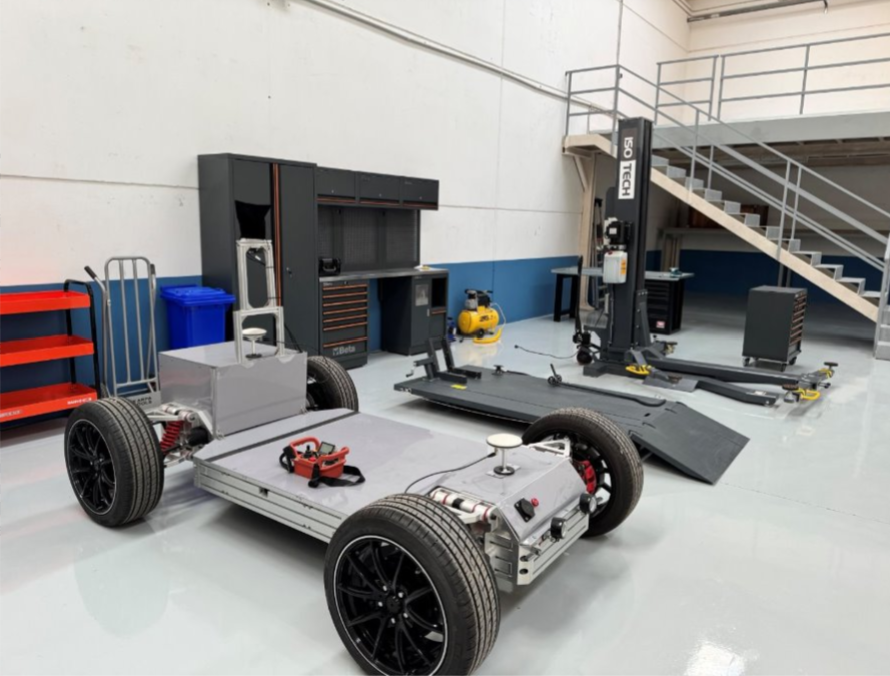
Real autonomous chassis integrated into MOVDATA, the mobility and logistics data space of Mobility Lab Vitoria-Gasteiz.
What is it?
Design, development and deployment of an educational platform based on a real autonomous chassis integrated into MOVDATA, deployed in the Mobility Lab Vitoria-Gasteiz sandbox so that students in Automotive and IT vocational training programmes can work and experiment with real-time telemetry from a moving autonomous vehicle, developing skills in advanced diagnostics, mobility data analysis and vehicle cybersecurity aligned with the needs of the CCAM (Connected, Cooperative and Automated Mobility) industry. The work is structured around two main lines:
1. Programming and operating the Phebus autonomous chassis in a real environment at the Technology Park.
2. Integration into MOVDATA, the Mobility Lab's data space, sending and consuming vehicle telemetry.
The challenge: training in connected autonomous mobility
Simulators and virtual environments do not reproduce the complexity or the wealth of data of an autonomous vehicle operating in a real physical environment.
-

Insufficient simulators
Current virtual environments do not allow training with the richness of data from a real moving autonomous vehicle.
-

No precedent in vocational training
No vocational training centre in the Basque Country or Spain yet works with real telemetry connected to a sovereign European data space.
-

Research–classroom gap
Mobility Lab and MGEP-SSE already work with these technologies, but they have not yet reached vocational training classrooms.
-

Emerging CCAM skills
Industry demands profiles with skills in LiDAR sensors, cameras, radar, telemetry and vehicle cybersecurity.
Project approach
The project combines the operation of a real autonomous vehicle, integration into MOVDATA and management of access to the laboratory.
- Programming of the Phebus autonomous platform.
- Integration into MOVDATA
It is designed as a flexible and scalable tool, intended for implementation in other educational centres:
-
 Modularity: content blocks and tools that can be used independently or combined
-
Open documentation: guides and materials that make it easy to replicate in other centres
-
 Contextual flexibility: each centre adapts the approach, timing and tools to its own context
-
 Dynamic evolution: each implementation enriches the project with new contributions
Project objectives
Deploy a complete educational pilot in connected autonomous mobility and transfer its resources to the entire Basque vocational training network (FP Euskadi).
-
1
Operational pilot at the Technology Park
-
2
Turn data into operational value
-
3
Validate 2 CCAM use cases
-
4
Publish the Online Teaching Platform
-
5
Transfer resources to the vocational training network
-
6
Key indicators to measure the impact of interoperability on efficiency, coordination and logistics sustainability
-
Optimising logistics processes
Operational improvement in goods coordination and management.
-
Cut in operating times
Less friction between stakeholders and platforms.
-
Increased interoperability
Increased capacity for connection between systems and operators.
-
Enhancing decision-making
Access to shared, contextualised information.
-
Driving sustainable models
Fostering combined transport and reduced environmental impact.
-
Scalability of the model
How far the system can be replicated in other logistics corridors and ecosystems.
Pilot scheme at Mobility Lab Vitoria-Gasteiz
A strategic logistics environment to validate new data services for intermodal transport

Júndiz Industrial Estate
Vitoria-Gasteiz, Spain
The DataLOG pilot scheme is run in the CTVi–Júndiz logistics environment, one of the main intermodal hubs in southern Europe. This location connects roads, railways and strategic ports, offering a real context in which to validate data services aimed at intermodal logistics.
Target audience:
-
Logistics and intermodal transport operators
Coordination of operations, monitoring of goods and optimisation of processes.
-
Logistics platforms and administrations
Tools to improve planning and management of goods transport.
The solution: connected autonomous mobility educational platform
A pilot deployed in four phases, from technical integration to full transfer to the vocational training network.
Characteristics:
-

Phase 1: Integration
-
Phase 2: Use cases
-

Phase 3: Resources and Online Teaching Platform (PDO)
-

Phase 4: Consolidation
-

Tknika evaluation
Components:
-
Configure the EDC connector for Mendizabala and Mondragon Unibertsitatea and connect the Phebus chassis to MOVDATA (Sep–Nov 2026).
-
Operate the chassis in inter-site logistics use cases and carry out predictive inspection (Dec 2026–Feb 2027).
-
Design ETHAZI challenges and develop the Online Teaching Platform (PDO) (Mar–May 2027).
-
Evaluate the pilot, gather feedback and publish the final report with Tknika (Jun–Jul 2027).
-
Pass Tknika's final evaluation according to the call's standard procedure.
Timeline and milestones
Key phases in the design, deployment and validation of the DataLOG use case in the Vitoria-Gasteiz logistics environment.
-
2024
DESIGN AND DEFINITION
- Definition of the use case
- Identification of actors
- Functional design
- Preparation of the pilot scheme
-
2025
DEVELOPMENT AND INTEGRATION
- Technological development
- Systems integration
- Setting up services
- Preparation of the environment
-
2026
VALIDATION IN REAL ENVIRONMENT
- Starting up the pilot scheme
- Operational monitoring
- Assessment of results
- Optimisation of the model
-
2027
SCALING AND TRANSFER
- Final validation
- Replicability of the model
- Extension to new hubs
- Transfer to the market
Results of the project
The project makes it possible to validate data services for intermodal logistics, generating improvements in efficiency, interoperability and sustainability.
- 4 Connected strategic lines
- 1 Pilot scheme under way in the CTVi–Júndiz logistics hub
- 20+ Logistics and technology stakeholders involved
- 100% Oriented towards interoperability and secure data sharing
Entities and participation
A project focused on autonomous mobility, data spaces and knowledge transfer to the vocational training network and companies in the mobility ecosystem.






Funding
Project funded by the Basque Government – Call for grants for innovation and entrepreneurship projects.
the implementation of innovation and entrepreneurship projects
Implementation period: 2026–2027

Take part in the Autonomous Campus project
Conecta con el proyecto y explora oportunidades de colaboración