
PARK4DIS
Pilot scheme for monitoring disabled parking spaces using sensors and automatic permit verification
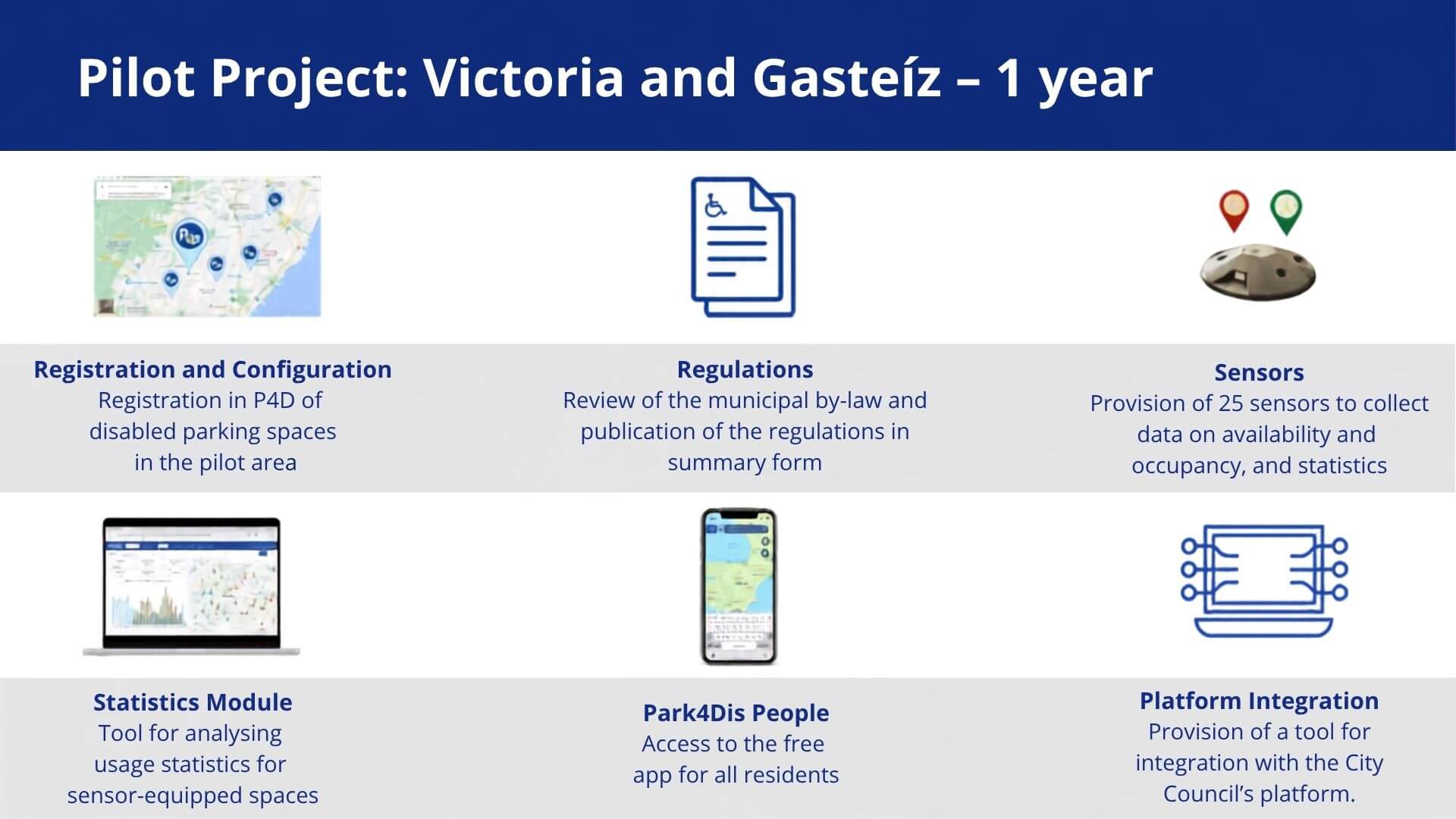
5 sensor-equipped disabled parking spaces in Vitoria-Gasteiz, integrated into Solmes’ Park4Dis app.
What is the project?
The project involves fitting sensors to five disabled parking spaces in Vitoria-Gasteiz to monitor their actual usage and automatically verify parking permits via the Park4Dis app.
The project is structured around three main areas:
1. Monitoring the actual usage of the five sensor-fitted disabled parking spaces throughout 2025.
2. Displaying real-time occupancy status and providing guidance to the space via the Park4Dis app.
3. Automatic verification of permits using QR codes and authentication at the parking space itself.
The challenge: disabled parking spaces with no data and unverified permits
At present, there is no information available on the actual occupancy of PR parking spaces, and permits are checked by manually cross-referencing number plates.
-

Lack of disabled parking spaces
Those surveyed cite the shortage of reserved places as the main barrier.
-

Manual verification
The validation of disabled parking permits in Vitoria-Gasteiz is carried out by manually checking number plates.
-

No occupancy data available
The user does not know whether the space is free or taken before setting off.
-

New European framework
The European Disability Card and the European Parking Card require interoperable accreditation.
Project approach
The pilot scheme combines the use of sensors at bus stops, automatic ticket validation and the direct involvement of passengers.
- Installation of sensors for 5 disabled parking spaces
- Automatic verification of permits
- Involvement of disabled users
It is designed as a flexible and scalable solution, intended to be rolled out to other towns and cities:
-
 Scalability: the sensor system can be replicated in any PRM car park in the city
-
Interoperability: aligned with the European Disability Card and the European Parking Card
- Co-design: features are validated with users and organisations working in the field of people with reduced mobility
-
 Continuous improvement: data from the pilot scheme is guiding the development of new features for the Park4Dis app
Project objectives:
To monitor the actual use of disabled parking spaces and test new features that improve users’ daily mobility.
-
1
Monitor 5 disabled parking spaces throughout 2025
-
2
Enable automatic permission checking
-
3
Check availability and get directions in real time on Park4Dis
-
4
Include people with reduced mobility in the pilot scheme
-
5
Streamlining the police’s handling of offences
The solution: sensor-equipped disabled parking spaces and the Park4Dis app
A pilot scheme rolled out in four phases, from the installation of the sensors to the evaluation involving users.
Areas of development:
-
Phase 1: Sensor installation
-

Phase 2: Monitoring
-
Stage 3: Verification
-

Stage 4: Assessment
-

User participation
Technological capabilities:
-

Sensors installed at five disabled parking spaces, two on Gabriel Celaya Street (late 2024).
-

Monitoring of actual car park usage and peak times, from 5.00 pm (2025).
-

Registration on Park4Dis and authentication at the car park using a QR code and a time limit.
-

Feedback from users and organisations, and proposals for new places.
-

Surveys on the app’s ease of use, guidance and the handling of offences.
Organisations and participation
A project focusing on universal accessibility, road safety and the direct involvement of people with reduced mobility.


Funding
Project funded by the MobilityLab Foundation
Implementation period: 2023–2025
